Yet we know surprisingly little about the people who sit in these parliaments. Research on authoritarian elites has mostly looked at single countries, such as China or Russia, or at the very top of the regime, meaning leaders and their cabinets. Ordinary MPs have largely been missing from the picture.
My new article in the Journal of Peace Research introduces a dataset that fills this gap, Parliamentary Elites in Authoritarian Regimes (PEAR). Alongside it, I have launched the PEAR Data Explorer, a free interactive tool that lets anyone explore the data without statistical software.
What is in PEAR?
PEAR covers more than 230,000 MPs who sat in 882 parliaments across 133 authoritarian regimes between 1945 and 2024. For each MP, it records
- their name, in the local language where possible and in English
- gender and year of birth
- party and, where relevant, electoral alliance
- whether they also sat in the previous parliament
- their constituency, where applicable
- whether they belong to the ruling party, a party that supports the regime, or the genuine opposition
PEAR then summarises each parliament. The summaries cover the share of women, the average age, the shares of young and older MPs, the number of parties, and the share of MPs who kept their seat from the previous parliament. Each figure is also available separately for the ruling party, its allies and the opposition.
The data come from public sources, including parliamentary websites, electoral commissions, the Constituency-Level Elections Archive, election observer reports, books on political elites in individual countries, and earlier data collection by colleagues. The article’s appendix lists the sources for every country.
What is new about it?
1. Its scale. Existing datasets on legislators mostly cover democracies, or include only a handful of autocracies or elections. PEAR covers 60% of all parliaments in autocracies since 1945, and nearly all of them since 1990.
2. It separates the genuine opposition from the loyal one. Many authoritarian parliaments include parties that officially compete against the ruling party but in practice support the regime. Examples are the Communist Party of the Russian Federation and FUNCINPEC in Cambodia. PEAR counts a party as regime-supporting if it forms an electoral alliance with the ruling party, backs the incumbent’s election bid, supports the ruling party in parliament, or holds a cabinet post. You can therefore see how much of a parliament’s “opposition” actually opposes the regime.
3. It follows careers. Because MPs are matched from one parliament to the next, PEAR shows how many keep their seats. This has not been possible across autocracies before. One finding from the article concerns personalist regimes, where power is concentrated in one leader rather than a party. In these regimes, the share of regime-supporting MPs who keep their seats is on average 7.7 percentage points lower than in party-based regimes. Leaders who reshuffle their cabinets often seem to reshuffle their parliaments too.
Explore the data
The PEAR Data Explorer is at felixwiebrecht.com/pear. It has three views:
- World map. Pick a variable and a year to see the parliament in office in each country at that time.
- Trends over time. Compare up to six countries on any variable, for all MPs or separately for the ruling party, its allies or the opposition.
- Country profile. A parliament-by-parliament summary for a single country.
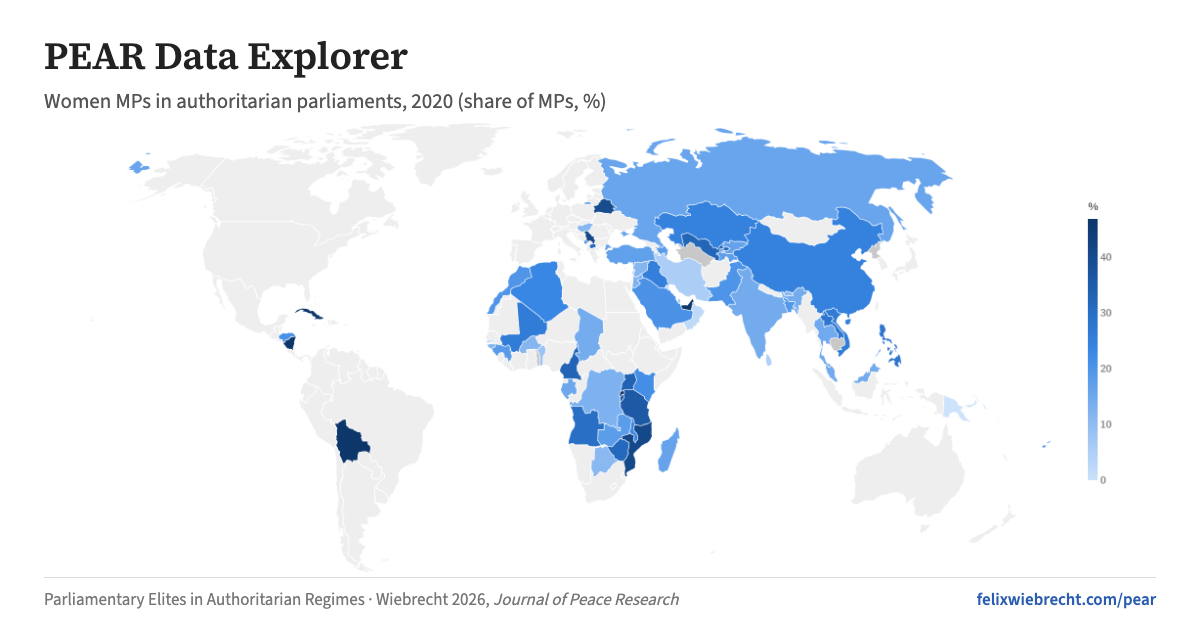
A note on gaps. Age and party information is not available for every MP. The Explorer therefore only shows figures based on age, gender or party where PEAR covers nearly all seats in that parliament. Elsewhere, it shows how complete the data are instead of a potentially misleading number. Charts can be downloaded as PNG, JPEG, PDF or SVG, and the full dataset, codebook and article are linked on the page.
The data may be useful to journalists, analysts and anyone working on democracy support or foreign policy, as well as to researchers.
What comes next
Over the coming weeks, I will publish a series of short posts drawing on PEAR. I will also work on extending coverage beyond 2024 and adding more variables. In the meantime, I welcome comments, questions and corrections. If you spot an error for a country you know well, please get in touch at felix.wiebrecht@liverpool.ac.uk.
Reference: Wiebrecht, Felix. 2026. "Parliamentary Elites in Authoritarian Regimes: New Data." Journal of Peace Research. https://doi.org/10.1093/jopres/xjag087
]]>